

By 5:30 a.m. every morning, Metro’s painters are already on the move.
They gather at Metro’s maintenance and support facility on Pacific Boulevard in Vernon – the team’s home base – where they review assignments, load trucks with supplies and prepare for a day that could take them almost anywhere in the Metro system.
Some will head out to train stations, while others may work at bus facilities, parking lots, Metro headquarters, or other locations. Together, they apply fresh coats of paint to maintain structures, surfaces, and safety signage that are seen and used by millions of passengers every year.
“My team is in charge of bringing color to Metro,” says Angie Godinez, Facilities and Property Maintenance Supervisor. Their canvas is enormous.


Her 16-member team maintains painted surfaces across Metro’s 115 rail stations, 17 bus and rail divisions. On any given day, that may mean painting walls, fences, elevators, light poles, doors, signage and planters or restriping employee and customer parking lots. Behind the scenes, they also bring the same attention to detail to offices, restrooms, kitchens and other employee spaces.
The work also requires a keen eye for color. “Sometimes you have to adjust and mix colors rather than simply opening a bucket and painting,” says painter Ernesto ‘Ernie’ Raigoza. “Every now and then, you have to play chemist.”
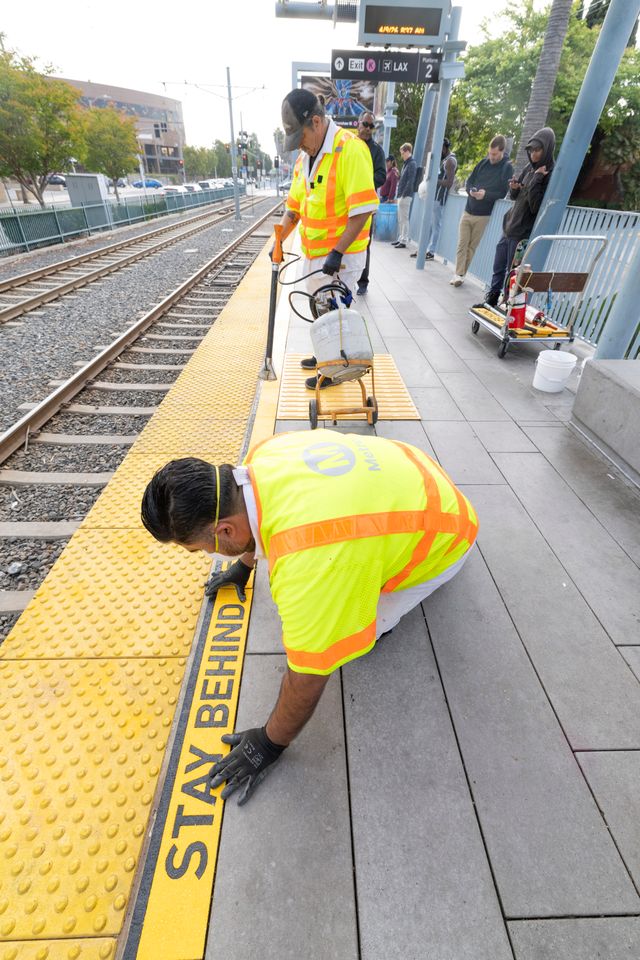
But not every project involves painting. One of the team’s most specialized responsibilities is installing safety markings, including the ‘Stay Behind Yellow Line’ found at Metro rail stations.
“We do that through a process called thermoplastic,” says Juan Raigoza, a Metro painter who has worked at the agency for 10 years.
This technique begins by removing the old material and cleaning the surface. Painters then apply a sealer before positioning the new thermoplastic pieces and warning-line stencils. Once everything is in place, they use a torch to heat the material and bond it to the surface.
“A lot of this work is for people’s safety,” Juan says. He adds that the most rewarding part of the job is seeing the public appreciate the team’s work. “They say that we’re doing a great job, that Metro is doing a good job,” he says. “It feels great to be able to help out and see people smile when they come to the stations.”



Safety is a major part of the team’s work. Painters regularly inspect stations throughout the system and help identify areas that need attention. “If we notice there’s anything that needs to be fixed to ensure public safety, we go back and remediate it immediately,” Angie says.
Some stations require more frequent maintenance than others. A good example is the A and E Line’s Pico Station, one of Metro’s busiest stops in Downtown LA.
“We go out there every three months to check on its condition,” Angie says. “A lot of times the fencing gets worn out quickly and the benches require additional attention.”
In addition to routine maintenance, the team also takes on special projects. Over the past year, painters completed refurbishment work along the C Line, refreshing elevators, lamp posts and more. They have also worked at the Harbor Freeway Station, a key transfer point for riders.


One of the most visible projects this year took place at North Hollywood Station, a major transit hub that serves the B Line and connects riders to numerous bus routes in the San Fernando Valley. Painters there refreshed the station’s iconic dome structure, fencing, bus canopies and benches as part of ongoing efforts to keep the station welcoming and well maintained.
One quick Metro fact: the bus canopies and benches at NoHo Station were not included by accident! While more than 90% of the bus stops Metro serves are maintained by local cities, the facilities at NoHo Station are located on Metro property, which made them part of the team’s responsibilities.


This project required quite a preparation. “We sanded it, scraped the loose material, did some patching and applied the prime,” explains painter Anselmo Muñoz. “After that, we applied two coats of paint.”
The work was completed in less time than expected. “They gave us a month to do it,” Anselmo remembers. “We put in a lot of hours and brought in additional personnel to meet the goal, and we were able to finish ahead of schedule.”
For painter Martin Garcia, seeing the transformation is one of the most rewarding parts of the job. “When you see the work from the beginning to the end, it’s amazing what a paint job can do,” says Garcia. “At the end you look and think, ‘Wow.’”
While Los Angeles prepares to welcome visitors from around the world for the upcoming World Cup, the team says its focus remains on the people who use Metro every day. “We do this for the public, for the locals because they’re the ones who see it every day,” Martin says.
Metro has many painters working behind the scenes, but their work can be seen throughout the system – in the color, care and attention they bring to every project. “I feel very proud of what I do,” says Anselmo. “I believe we give life to the stations.”

Discover more from The Source
Subscribe to get the latest posts sent to your email.